Radiation Therapy in Neurooncology: Overview
Radiation therapy is a fundamental component of modern neurooncology and plays a central role in the treatment of both primary and metastatic tumors of the central nervous system. It is used across a wide range of clinical scenarios, including curative, adjuvant, and palliative settings, and is often integrated with neurosurgery and systemic therapies as part of a multimodal treatment approach.
Advances in radiation technology, imaging, and treatment planning have significantly improved the precision of radiation delivery, allowing higher doses to be directed to tumor tissue while reducing exposure to surrounding healthy brain structures. Despite these advances, the use of radiation therapy in neurooncology requires careful consideration of potential benefits and long-term risks.
What Is Radiation Therapy?
Radiation therapy is a medical treatment that uses high-energy radiation to damage the DNA of tumor cells, thereby inhibiting their ability to divide and survive. In neurooncology, radiation is most commonly delivered using external beam techniques, where radiation is generated outside the body and directed toward a defined target within the brain or spinal cord.
Tumor cells are generally more susceptible to radiation-induced damage than normal cells due to impaired DNA repair mechanisms and uncontrolled proliferation. However, normal brain tissue is also sensitive to radiation, which necessitates precise targeting and careful dose planning.
Principles of Radiation Therapy
The biological effect of radiation therapy is based on the induction of DNA damage, either directly or indirectly through the generation of free radicals. This damage interferes with cellular replication and leads to tumor cell death over time.
Radiation therapy is typically delivered in multiple small doses, known as fractions, over several weeks. Fractionation allows normal tissues to repair sublethal damage between treatments while maximizing cumulative damage to tumor cells.
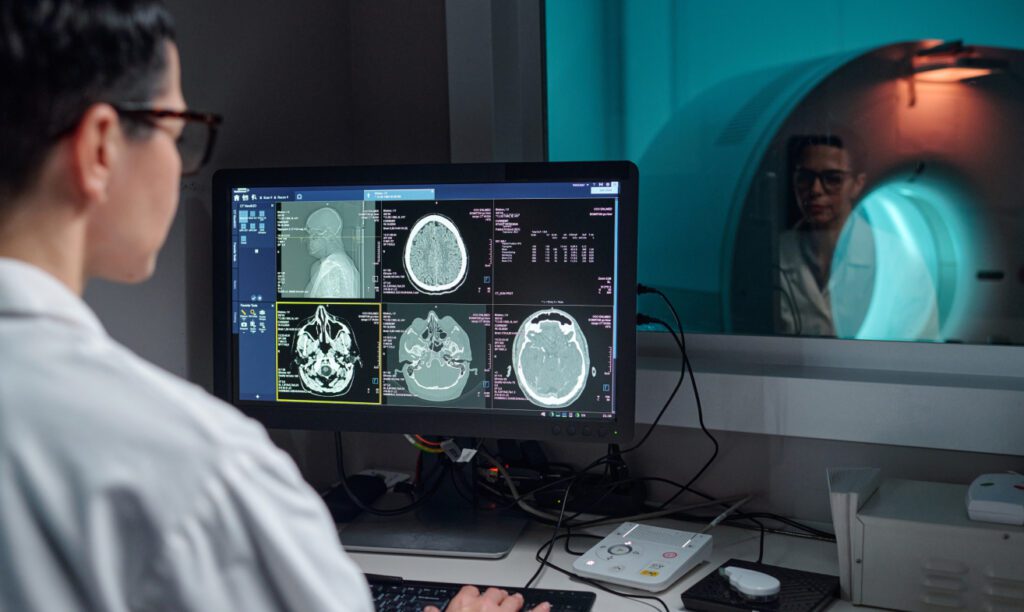
In neurooncology, treatment planning is guided by detailed imaging, most commonly magnetic resonance imaging (MRI), to accurately define tumor boundaries and areas at risk for microscopic disease extension.
When Radiation Therapy Is Used in Neurooncology
The timing and role of radiation therapy depend on tumor type, grade, location, molecular characteristics, and overall treatment strategy.
Radiation therapy may be used:
-
After surgery (adjuvant therapy) to treat residual tumor cells and reduce the risk of recurrence
-
As a primary treatment when surgical resection is not feasible or carries unacceptable risk
-
In combination with systemic therapy, such as chemotherapy
-
For recurrent disease, depending on prior treatments and cumulative radiation dose
-
For symptom control in selected palliative situations
The decision to use radiation therapy and its specific parameters is individualized and typically determined through multidisciplinary evaluation.
Conventional Radiation Therapy
Conventional radiation therapy in neurooncology is most commonly delivered using photon-based external beam radiation generated by a linear accelerator.
Modern photon radiation techniques include:
-
Three-dimensional conformal radiation therapy (3D-CRT)
-
Intensity-modulated radiation therapy (IMRT)
-
Image-guided radiation therapy (IGRT)
These approaches allow radiation beams to be shaped and modulated to conform closely to the tumor volume, thereby reducing dose to adjacent normal tissues. Photon-based radiation therapy remains the most widely used and extensively studied modality in neurooncology.
Proton Therapy
Proton therapy is an alternative form of external beam radiation that uses protons rather than photons. The physical properties of protons allow most of the radiation dose to be deposited at a specific depth, known as the Bragg peak, with minimal exit dose beyond the target.
This characteristic can reduce radiation exposure to surrounding normal brain tissue, particularly in cases where tumors are located near critical structures. As a result, proton therapy may be considered in selected patients where minimizing long-term radiation-related toxicity is a priority.
It is important to note that proton therapy does not inherently increase the biological effectiveness of radiation against tumor cells. Its primary potential advantage lies in dose distribution rather than improved tumor control. The choice between proton and photon therapy depends on individual anatomical, clinical, and technical factors.
Differences Between Proton Therapy and Conventional Radiation Therapy
The fundamental difference between proton therapy and conventional photon-based radiation therapy lies in how radiation energy is deposited within tissues.
Photon radiation delivers dose along its entire path through the body, including an exit dose beyond the tumor. Proton radiation, by contrast, delivers most of its energy at a defined depth, which may allow for reduced exposure of healthy tissues beyond the target volume.
From a clinical perspective, both modalities aim to achieve effective tumor control. Differences in outcomes are primarily related to toxicity profiles rather than consistent differences in tumor response. The relative benefits of proton therapy vary depending on tumor location, patient age, and proximity of critical neural structures.
Long-Term Outcomes and Considerations
Long-term outcomes following radiation therapy in neurooncology depend on multiple factors, including tumor biology, total radiation dose, fractionation schedule, patient age, and baseline neurological function.
Potential long-term effects of radiation therapy may include cognitive changes, endocrine dysfunction, vascular effects, and, rarely, radiation-induced secondary tumors. Advances in treatment planning and delivery have reduced these risks, but they remain an important consideration, particularly for patients with long expected survival.
Ongoing follow-up with clinical assessment and imaging is essential to monitor treatment response, detect recurrence, and identify late effects of therapy.
Conclusion
Radiation therapy remains a cornerstone of treatment in neurooncology and is integral to the management of many brain and spinal tumors. Its use is guided by well-established biological principles and continues to evolve with technological advances.
Both conventional photon-based radiation therapy and proton therapy play important roles, with selection determined by individual clinical circumstances rather than a universal hierarchy of effectiveness. Long-term outcomes reflect a balance between tumor control and preservation of neurological function, underscoring the importance of careful treatment planning and multidisciplinary care.
The article was medically reviewed by the Neuro-Oncology Team
Last update: December 14, 2025
Neuro-oncology Institute, Barcelona.